
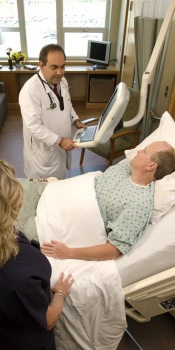
Next-Generation Hospital Design Can Improve Health—and Save Money
Visit www.thehastingscenter.org/FableEssays to download the complete essay set.
A set of articles in the Hastings Center Report examines the state of the evidence for these design features, looks inside two hospitals that put some of these innovations into practice, and considers how design fits into the moral mission of health care.
- “Fable Hospital 2.0: The Business Case for Building Better Health Care Facilities.” The lead article gives a thorough analysis of research that shows that specific design innovations can yield enormous benefits, such as reducing health care-related infections in patients and occupational injuries to nurses, as well as cutting energy use. These benefits, in turn, reduce costs, leading to a return on investment within three years, write the authors, who are leaders in health care management and design. The lead author is Blair Sadler, a senior fellow at the Institute for Healthcare Improvement and past president and CEO of Rady Children’s Hospital, San Diego, and former CHD Board Member. He is co-author of Transforming the Health Care Experience through the Arts and is a fellow and board member of The Hastings Center.
- “Case Study: Dublin Methodist Hospital.” Cheryl Herbert, president, supervised the construction of this new hospital in Ohio, which features all private rooms, abundant natural light, and noise-reducing materials. Among the positive outcomes were a low rate of health care-acquired infections and patient falls with injury. “We calculated that the evidence-based design elements we incorporated were 2.5 percent of the total project cost of $150 million,” she writes. “Our results tell us it was worth it.”
- “Case Study: Sacred Heart Medical Center.” The plan to incorporate evidence-based design features such as “soothing impressionistic art” and views of the natural landscape into Sacred Heart Medical Center in Oregon initially met resistance, writes Alan Yordy, president and chief mission officer of PeaceHealth, the parent organization. “A few community members were skeptical that this was anything more than a justification for building an expensive ‘Hospital Hilton.’” But the new facility has demonstrated several benefits over the one it replaced, including reduced lengths of stay and costs of discharge.
- “Values Engineering: The Ethics of Design in Community Health Centers.” Federally funded community health centers, which serve the neediest patients, are incorporating evidence-based design to support the ethics of expanding access to health care, write Benjamin Boltin, a consultant specializing in the design, construction, and operation of federally qualified health centers, and Nancy Berlinger, a research scholar at The Hastings Center. Among the examples they cite is a mobile health van that brings health services to migrant workers in across northwestern New Jersey. The van is “green,” operating on biodiesel and including a solar array to minimize the environmental impact.
------------------------------------------
The Hastings Center is a nonpartisan bioethics research institution dedicated to bioethics and the public interest since 1969. The Center is a pioneer in collaborative interdisciplinary research and dialogue on the ethical and social impact of advances in health care and the life sciences. The Center draws on a worldwide network of experts to frame and examine issues that inform professional practice, public conversation, and social policy. Learn more about The Hastings Center at www.thehastingscenter.org.